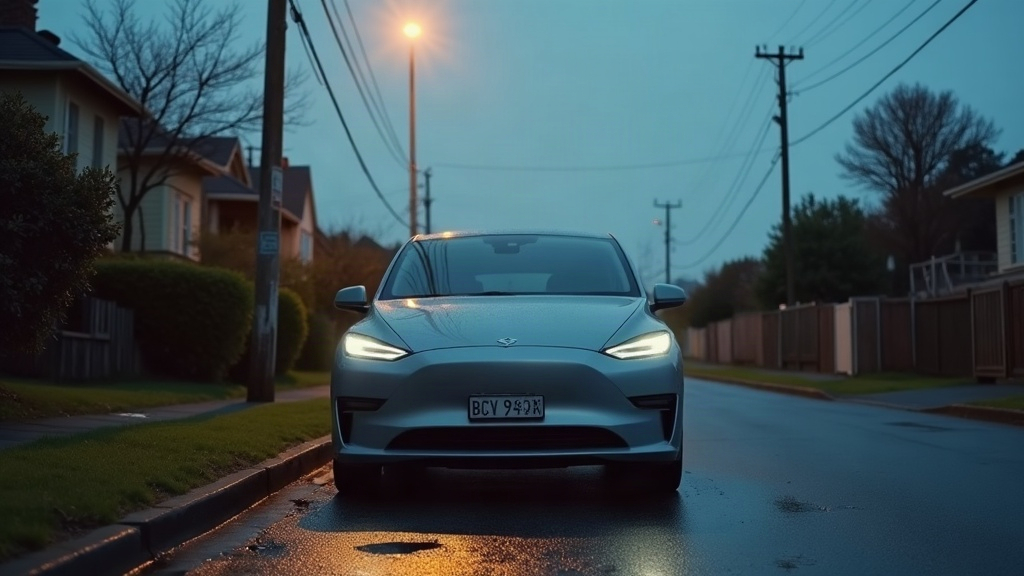
What it actually costs to run an EV in Canterbury right now
The NZ Angle
Light electric vehicles lost their RUC exemption in April 2024, and the rate has since been set at $76 per 1,000 km for EVs under 3,500 kg. That changes the running-cost equation in ways that the Clean Car Discount era obscured. Canterbury drivers face an additional wrinkle: the South Island grid runs cleaner than the North, which is a small environmental win, but home-charging tariffs through Meridian or Contact are still sitting around 30-35 cents per kWh on standard residential plans, and off-peak rates require either a controlled circuit or a smart meter setup that many older Canterbury homes don't have. Petrol, meanwhile, is hovering around $2.50-2.70 per litre in Christchurch at time of writing. The practical comparison here is between a 2020 Nissan Leaf (40 kWh, common on the used market at $18,000-$24,000), a 2023 BYD Atto 3 (58 kWh, new or near-new at $45,000-$55,000), a Toyota Aqua hybrid (around $14,000-$20,000 used), and a Toyota Corolla 2.0-litre petrol (around $22,000-$30,000 used). The WoF interval drops to annual after three years for all of them, so that's a wash.
RUCs are here, power prices haven't dropped, and the maths on a Nissan Leaf or BYD Atto 3 versus a hybrid or petrol car is closer than the EV lobby would like.
The argument for electric vehicles used to be simple: charge at home for cents, skip the forecourt, feel good about it. That argument still has legs, but they're shorter now than they were in 2022, and anyone buying a used Leaf or a new Atto 3 in Christchurch today deserves a clear picture of what they're actually signing up for.
Let's put real numbers on it.
The EV running costs
A 2020 Nissan Leaf with the 40 kWh battery will use roughly 18 kWh per 100 km in real-world Canterbury driving, which includes some cold-weather degradation in winter and the odd heater doing its job. At 32 cents per kWh (a reasonable average across standard residential plans, acknowledging some people will do better and some worse), that's $5.76 per 100 km in electricity alone.
Then add RUCs. At $76 per 1,000 km, that's 7.6 cents per kilometre, or $7.60 per 100 km.
Combined running cost for the Leaf: roughly $13.36 per 100 km.
The BYD Atto 3, with its 60.5 kWh usable battery, is a slightly more efficient vehicle in real terms, coming in around 17-18 kWh per 100 km. Call it 17.5 kWh, so $5.60 in power at the same tariff. RUC is the same rate. Total: about $13.20 per 100 km. Barely different to the Leaf.
Servicing on both is genuinely cheaper than a combustion car. No oil changes, no cam belts, simpler brakes. Budget $300-$500 per year for a Leaf, maybe a little more for the Atto 3 while it's in warranty. That saving is real and it compounds over time.
The petrol and hybrid comparison
A Toyota Corolla 2.0-litre petrol returns about 7.5-8.5 litres per 100 km in mixed Canterbury driving. At $2.60 per litre, that's $19.50-$22.10 per 100 km in fuel. No RUC, because petrol cars pay road user charges at the pump through the fuel excise duty, roughly 70 cents per litre embedded in that price. Servicing runs $600-$900 per year at a minimum.
The Toyota Aqua hybrid, one of the most common used imports in Canterbury, does significantly better: around 4.2-4.8 litres per 100 km. At $2.60, that's $10.92-$12.48 per 100 km. Still no RUC to worry about. Servicing is comparable to the Corolla, maybe marginally cheaper.
Here is what that actually means side by side, at 15,000 km per year:
Nissan Leaf: roughly $2,004 in electricity plus $1,140 in RUC. Total fuel/road cost: $3,144.
Toyota Aqua: roughly $1,638-$1,872 in petrol. No RUC add-on.
Corolla 2.0: roughly $2,925-$3,315 in petrol.
BYD Atto 3: $3,132 total fuel and road cost.
The Leaf and the Atto 3 are cheaper to run than the Corolla. They are not, or at least not by much, cheaper to run than a well-sorted Aqua hybrid. That gap narrows further if you can access off-peak charging, and widens again if your home electricity is on a higher tariff or you're doing a lot of charging away from home at public rates, which in Christchurch typically run 55-65 cents per kWh through ChargeNet.
What the numbers actually tell you
The Leaf, bought used at $20,000, is still a reasonable proposition. The running cost is competitive with a Corolla and close to an Aqua. The catch is battery degradation: a 2020 Leaf in the New Zealand used market often has 85-90% state of health, meaning real-world range of 180-210 km rather than the 270 km headline figure. In Canterbury winter, subtract another 15-20% from that. It is a city car and a commuter. It is not a reliable way to do Christchurch to Queenstown and back without planning.
The Atto 3 is a different vehicle. It has real range, better build quality, and active thermal management on the battery. It also costs $45,000-$55,000 new, which means the running-cost savings do not close the purchase price gap against a $24,000 Aqua in any realistic timeframe. You buy the Atto 3 because you want a good car, not because the maths compels you.
The broader point is this: RUCs have not made EVs uneconomical. They have made the Aqua hybrid look more rational than it ever has. For anyone doing high mileage on a budget, a clean Japanese hybrid import might now be the honest value play, and it's worth saying that plainly even if it's not what the zeitgeist wants to hear.
The forecourt is still more expensive than the socket. But the socket is no longer the sure thing it was.
By Auto Luxe. See our editorial standards or email sales@autoluxe.co.nz with corrections.
More automotive

What a used EV actually costs to run in Canterbury now
The RUC exemption is gone and per-km charges are real. We crunch Leaf and Aqua ownership costs against a comparable petrol import to see if the numbers still work.

What Canterbury EV ownership actually costs per kilometre in 2026
RUC charges are locked in, power prices keep climbing. Here's what the numbers genuinely look like for Canterbury EV owners compared to a petrol import doing the same kilometres.
What Canterbury EV owners are actually paying per km in 2026
The RUC exemption for light EVs is gone. We run the real numbers on what it costs to drive a Leaf or Model 3 in Canterbury versus a petrol Prius or diesel X-Trail.