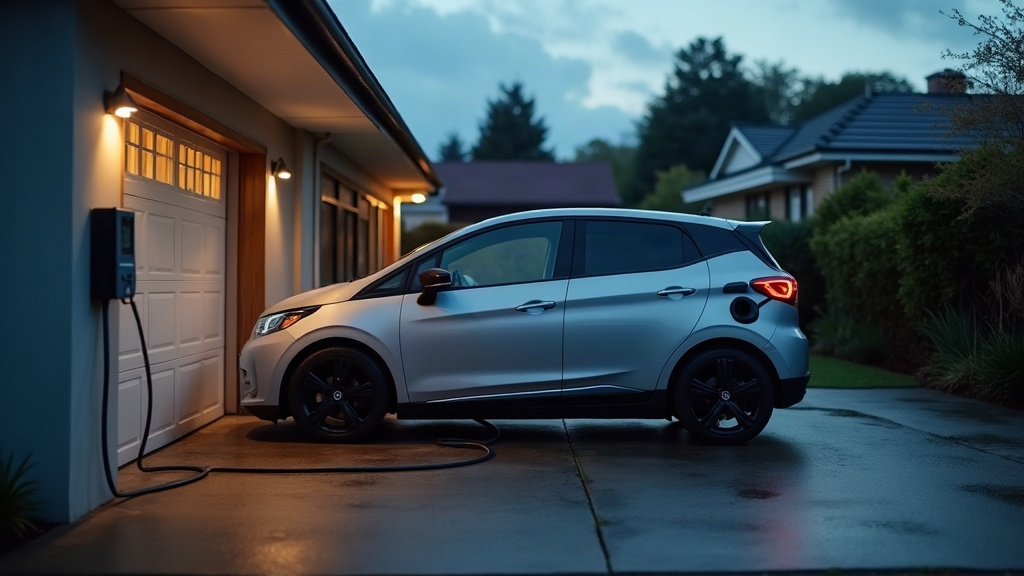
Leaf vs petrol hatch: what the running costs actually look like in 2026
The NZ Angle
New Zealand's road user charge regime for light EVs kicked in during 2024, and by now most Leaf owners have had at least one full annual cycle to feel what it costs. The rate sits at $76 per 1,000km as of mid-2026, which on a typical Canterbury commute of around 15,000km a year works out to $1,140 in RUCs alone. That's not trivial. For years, zero RUCs was one of the headline arguments for buying a used EV over a petrol car, and that argument has now been revised considerably. Petrol hatchbacks don't pay RUCs, but they do pay fuel excise duty embedded in the pump price, so the playing field isn't completely level — the RUC rate for EVs was always meant to approximate what petrol drivers pay through fuel tax. Whether it actually does depends on your car's efficiency and what you're paying per litre. Canterbury buyers also need to factor in that the Clean Car Discount ended in late 2023, so there's no longer a rebate softening the EV purchase price. What's left is the honest comparison: real costs, real numbers, no subsidy cushion.
RUCs on light EVs have been in place long enough to do the maths properly. Here's what a Canterbury commuter actually pays each year in a used Nissan Leaf versus a comparable petrol hatchback.
A tidy 2018 Nissan Leaf with 50,000km on it sits around $18,000 to $22,000 at most South Island dealers right now. A comparable 2018 or 2019 Toyota Corolla hatch or Mazda2 in similar shape runs $16,000 to $20,000. The EV premium at purchase has compressed significantly since the Clean Car Discount dropped out, but it hasn't disappeared. So the question is whether lower running costs still make up the gap over three to five years of ownership.
Let's use a realistic Canterbury commuter as the benchmark: 15,000km per year, home charging overnight, no long-distance driving anxiety to worry about.
What the Leaf costs to run
The 2018 Leaf (40kWh battery) returns around 6 to 6.5km per kWh in mixed real-world driving, so 15,000km requires roughly 2,400kWh annually. On a standard Christchurch residential rate of around 30 cents per kWh, that's $720 in electricity. Some households with a time-of-use plan get that down to $550 if they charge in the cheap window overnight. Call it $650 as a reasonable middle ground.
RUCs at $76 per 1,000km over 15,000km add $1,140. Total energy plus road tax: around $1,790 per year.
WoF is $65 to $75 depending on the shop, annual after three years. Registration runs about $115. Servicing on a Leaf is genuinely light — no oil changes, no belts, limited brake wear from regenerative braking. Budget $300 to $400 per year for a proper annual check, cabin filter, tyre rotation, and brake fluid flush every two years. Tyres are the same as any car: a set of four mid-range 215/50R17s runs $700 to $900 fitted.
The number to watch is battery health. An 80,000km Canterbury Leaf bought at $19,000 might be on 85 to 90 percent battery capacity, giving you a realistic winter range of 180 to 210km. That's still plenty for Christchurch to Rangiora and back twice over. But at 100,000km-plus, capacity loss becomes more variable. A battery replacement from Nissan is not a conversation you want to have — it's $12,000 to $15,000 for a new pack. Reconditioned options through local EV specialists are cheaper but not cheap.
What the petrol hatch costs to run
A 2019 Toyota Corolla hatch with a 1.8-litre engine returns around 7L/100km in real mixed driving. At $2.70 per litre (mid-range for Canterbury in 2026), 15,000km costs roughly $2,835 in petrol. A Mazda2 with the 1.5-litre engine does better, closer to 6.5L/100km, bringing that down to about $2,634.
No RUCs. Registration is the same, around $115. WoF is the same. Servicing is where it gets more expensive: oil and filter every 10,000km or annually at $120 to $180 a go, plus a timing chain or belt service in the 100,000km range depending on the engine. Budget $500 to $700 per year realistically for routine servicing on a petrol hatch at this age and mileage. Brakes wear faster than on a Leaf because there's no regenerative system sharing the load.
Total annual running costs for the petrol hatch, excluding tyres and insurance: roughly $3,550 to $3,750.
For the Leaf, the same calculation lands at roughly $2,370 to $2,590 — assuming no battery drama.
Does the EV premium still pay off
On pure running costs, the Leaf saves somewhere between $1,000 and $1,400 per year over a petrol hatch. On a $2,000 to $3,000 purchase price premium, that's a two-to-three year payback. Over five years, you're ahead by $3,000 to $5,000 in running costs, assuming nothing goes wrong.
The caveat is that last phrase. A petrol Corolla at 80,000km is a known quantity. Parts are local, any mechanic can service it, and the catastrophic failure scenarios are limited. A Leaf at the same mileage is also a solid car — Nissan's reliability record on the non-battery components is decent — but you're carrying battery degradation risk that the petrol car simply doesn't have.
Insurance is broadly similar between the two. A few insurers still charge a slight EV premium due to repair costs on modern bumpers and sensors, but it's usually under $100 a year difference at this price bracket.
RUCs have changed the equation but haven't killed it. At $76 per 1,000km, EV running costs are noticeably higher than they were pre-2024, but they still sit well below what you'll spend at the pump. The honest answer is that a used Leaf still makes financial sense for a commuter who can charge at home, buys a car with reasonable battery health, and keeps it for four or five years. If you're buying for two years and selling, the maths gets tighter. And if you're buying a high-mileage Leaf without getting a battery health check first, you're taking a punt that the savings assume you won't have to take.
By Auto Luxe. See our editorial standards or email sales@autoluxe.co.nz with corrections.
More automotive
What EV ownership actually costs per kilometre in NZ now
RUCs are locked in, charging costs are real, and the maths has shifted. We work through what Leaf, Atto 3, and Model 3 owners are paying once every cost is stacked up.

EV road user charges after a year: do the numbers still work for Canterbury buyers?
Light EV road user charges have been running for over a year. We crunch what Canterbury Leaf and Prius owners are actually paying versus what they're saving at the pump.

A year of full EV road user charges: what it actually costs
The RUC exemption for light EVs ended 1 April 2024. Twelve months on, we look at what that means for Leaf and BYD Atto 3 owners in Canterbury and whether the used-EV price case still holds.