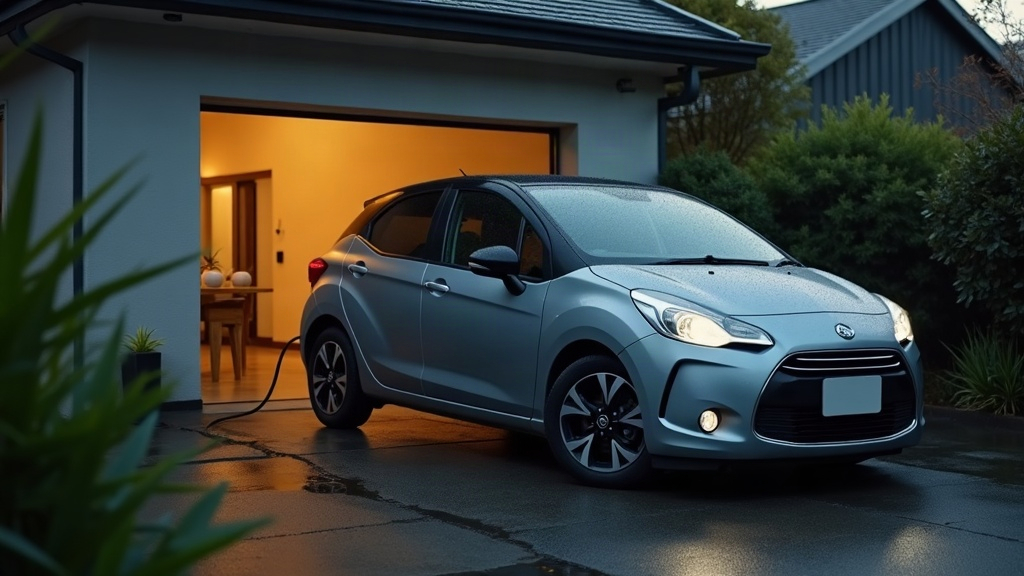
EVs under $25k: what Canterbury driving actually costs
The NZ Angle
Light electric vehicles lost their RUC exemption in April 2024, and the rate has since settled at $76 per 1,000km for EVs under 3,500kg. That's not trivial. A Canterbury driver covering 15,000km a year is looking at $1,140 in RUCs alone, on top of home charging costs and the annual WoF once the car clears three years old. The used Nissan Leaf, particularly the 40kWh ZE1 generation, has become one of the most-traded EVs on Trade Me Motors, with tidy examples sitting between $16,000 and $22,000. The BYD Atto 3 is newer and pricier, typically $28,000 to $38,000 used, which already pushes it past the $25k ceiling for most private buyers. What this means practically: the Leaf is the realistic sub-$25k EV option for most people, and the comparison that matters is a 2018 to 2020 Leaf against something like a 2018 Toyota Aqua or a 2017 Mazda Axela in the same price band. Canterbury winters add a layer the North Island buyer doesn't face: battery range drops meaningfully in sustained cold, and that 40kWh Leaf's real-world winter range around Christchurch is closer to 180km than the 270km WLTP figure suggests.
RUC rates have settled, used Leafs and BYD Atto 3s are everywhere on Trade Me. Here's what the numbers actually look like for a South Island buyer.
The RUC exemption for light EVs is gone, and anyone who bought a used Leaf two years ago expecting free running has had to adjust. That adjustment is worth quantifying before you commit to an EV purchase in 2025.
At $76 per 1,000km, RUCs on a light EV are not cheap, but they're not ruinous either. The comparison point is a diesel vehicle, which pays around $76 to $100 per 1,000km depending on weight. A petrol car pays nothing in RUCs but pays through the pump. At current South Island petrol prices, a Toyota Aqua averaging 4.5L/100km over 15,000km a year burns through roughly $1,800 to $2,025 in fuel. The Leaf's RUC bill for the same distance is $1,140. Home charging on a standard overnight rate, assuming around 18kWh/100km real-world consumption and a rate of $0.30/kWh, adds roughly $810 a year. So the Leaf's energy and road-user cost combined sits around $1,950 annually, nearly identical to the Aqua on petrol.
That's before you account for servicing. A Leaf has no oil, no timing belt, no transmission fluid on the CVT, and no spark plugs. Annual servicing on a Leaf at an EV-competent workshop typically runs $150 to $250 for a basic check, brake fluid test, and tyre rotation. The Aqua needs an oil service every 10,000km or 12 months, and while Toyota's parts are cheap and plentiful, you're still looking at $180 to $280 per service plus the occasional air filter and cabin filter. Servicing broadly evens out between the two.
The battery question nobody wants to dodge
Here's where the Leaf conversation gets uncomfortable. Nissan's first-generation Leaf, the 24kWh cars, are well known for degradation issues, and even the 40kWh ZE1 generation that most buyers are looking at now loses capacity faster than most EVs in its class. The ZE1 lacks active thermal management on the battery pack, which means it relies on passive air cooling. In Canterbury's summer heat and in repeated fast-charging scenarios, that takes a toll.
A 2019 Leaf ZE1 with 80,000km on it might show 10 to 12 bars on the battery health gauge, which sounds fine until you understand that the real-world drop from 12 to 11 bars represents a meaningful chunk of usable range. Buy a Leaf without checking the State of Health reading from a proper diagnostic tool, and you're guessing. Dealers selling these cars should provide an SOH report. If they won't, that tells you something.
A Leaf showing 85 percent SOH or better is reasonable. Below 80 percent on a 40kWh car, you're working with an effective pack closer to 32kWh, and real-world winter range in Canterbury drops to somewhere between 150 and 170km. That's workable for city commuting, but it removes any margin for a run to Methven or a day trip to Kaikoura.
The BYD Atto 3, by contrast, has active thermal management and a larger 60.5kWh LFP pack. The chemistry is more stable long-term and LFP cells handle both cold weather and regular fast-charging better than the Leaf's chemistry. But a clean used Atto 3 is $28,000 minimum, and most are $32,000 to $36,000. That's not a sub-$25k conversation.
What a petrol Japanese import actually costs at 150,000km
A 2018 Toyota Aqua in good order with 90,000km on it sits around $14,000 to $17,000 on Trade Me. A 2017 Mazda Axela 2.0 petrol is similar money. Both are fully complied, both have WoF history you can trace, and both have parts available locally from BNT, Repco, or via Japanese import channels within a few days.
At 150,000km, the Aqua's known costs are: hybrid battery health (the generation two pack is generally fine to 200,000km if it's been looked after), the 12V auxiliary battery around $180 to $250, and the CVT inverter coolant flush that dealers sometimes miss. None of these are expensive surprises if you're across them going in. Tyres for a 175/65R15 are $120 to $160 fitted, and the Aqua's gentle weight means they last well.
The Leaf's tyre story is less cheerful. The ZE1 runs 215/50R17 rubber, and the car's weight, around 1,580kg, means tyres don't last as long as on a lighter petrol hatchback. Budget $220 to $280 per corner on mid-range rubber.
Parts supply for the Leaf is generally fine through Nissan dealers and specialist EV parts importers, but it's not as straightforward as sourcing Toyota parts. If a Leaf needs a DC-DC converter or a charging port assembly, you're looking at longer lead times and higher labour costs at a specialist workshop.
Over five years and 75,000km, the honest running cost gap between a well-chosen Leaf and a comparable petrol Japanese import is smaller than most people expect, probably $1,500 to $3,000 in the EV's favour. Whether that justifies the battery degradation risk and the reduced range flexibility depends entirely on your driving pattern. For a Christchurch city commuter doing 40km a day, a good Leaf makes sense. For someone regularly driving to Queenstown or covering rural Canterbury, the petrol car remains the lower-risk choice at this price point.
By Auto Luxe. See our editorial standards or email sales@autoluxe.co.nz with corrections.
More automotive

Ex-lease Leafs and Atto 3s under $20k: what Canterbury buyers need to know
Used EVs are suddenly affordable, but battery health and RUC costs are the real variables. Here is what first-time electric buyers in Canterbury should check before signing anything.
Leaf vs Aqua: what it actually costs to run each car in Canterbury
The Clean Car Discount is gone and light EV RUCs are here to stay. We crunch the real weekly numbers on a used Nissan Leaf versus a Toyota Aqua for Canterbury drivers.
Leaf vs petrol hatch: what RUCs actually cost a Canterbury driver
The RUC exemption for light EVs is gone. We run the real numbers on a used Nissan Leaf versus a comparable petrol hatchback for a driver doing average annual kilometres in Canterbury.