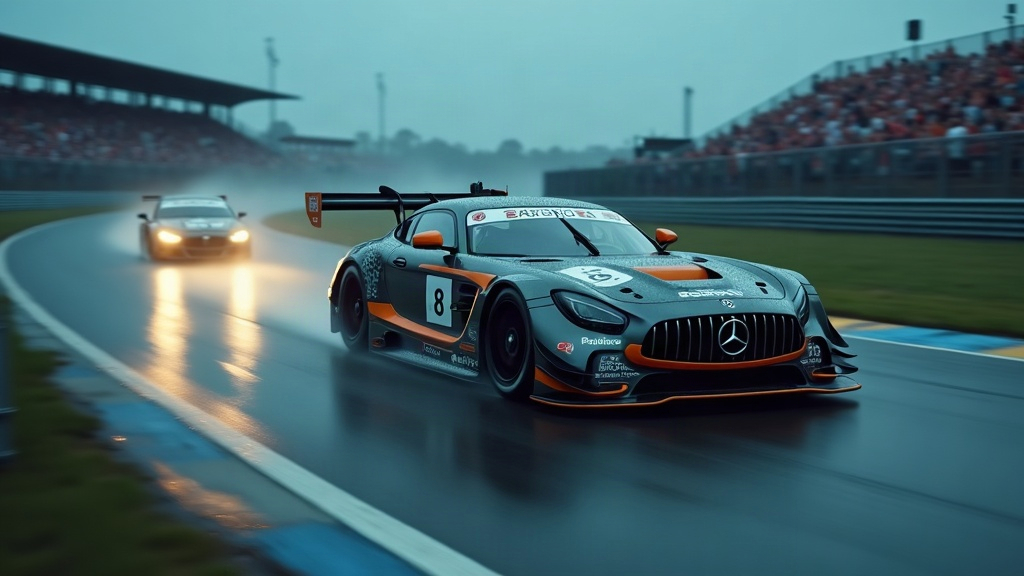
Van Gisbergen leads Kiwi charge as Supercars title fight tightens
The NZ Angle
Shane van Gisbergen has always carried a particular weight of expectation in New Zealand, the way few drivers in any series do. He came up through the local ranks — karting, the odd club day, the kind of formative racing that still happens at Pukekohe before the V8s stopped going there — and his trajectory through Supercars has been watched here with something closer to proprietary interest than casual fandom. His 2021 championship was the third for a Kiwi in the series, following Scotty McLaughlin's back-to-back titles, and it sustained a lineage that goes back further than most people remember. Now, with the championship deep into its second half and the calendar burning down, the question of whether van Gisbergen can sustain a title challenge while also managing the speculation around his future — his NASCAR programme opened doors that don't close quietly — sits at the centre of every Supercars conversation worth having. For New Zealand motorsport, the stakes are real. If SvG remains in contention through the final rounds, it keeps the series relevant to a domestic audience that has fewer and fewer touchpoints with international racing since Pukekohe dropped off the calendar.
Shane van Gisbergen's latest round result keeps him in the championship picture, while the broader Kiwi contingent in Supercars faces a run-home with little margin for error.
The concrete was still cooling at the most recent Supercars round when the points table told its familiar story: a championship that refuses to resolve itself cleanly, a handful of drivers capable of winning it, and Shane van Gisbergen somewhere in the argument.
Results from the round continued a pattern that has defined van Gisbergen's season — competitive on his day, occasionally undone by the margins that separate a podium from a points haul that actually moves the needle. He remains one of the most naturally gifted car controllers in the paddock, and the Red Bull Ampol Racing Camaro is no backmarker's tool. Whether the machinery and the results are aligning with the consistency the championship demands is a different question.
What the round produced
Without overstating a single weekend's result, the round reinforced the competitive shape of the 2024 season. Will Brown has been a genuine title threat all year, and Brodie Kostecki's return to form after a difficult mid-season stretch has complicated the mathematics for everyone. Van Gisbergen, for his part, has shown the kind of pace that reminds you why he held the championship for as long as he did, while also showing the rough edges — a contact incident here, a strategy call that didn't come off there — that have kept him from converting pace into a clean points lead.
One remembers that van Gisbergen's 2021 title was built on exactly this kind of racecraft: the ability to find pace when others couldn't, to salvage points from a compromised race, and to win when the pressure was highest. Whether the 2024 version of that mentality is fully switched on, given the obvious distractions of his NASCAR programme and the broader uncertainty about his Supercars future beyond this season, is a question the paddock whispers about but rarely asks directly.
For all that, a driver of his calibre running in the top five of the standings at this stage of the season is not a driver who has given up. The reverse is usually true.
The wider Kiwi picture
Beyond van Gisbergen, the Kiwi presence in the Supercars paddock is thinner than it was during the McLaughlin era, when New Zealand could claim the championship leader and a genuine title contender in the same sentence. The series has never been easy to break into from this side of the Tasman, and the pathways that produced van Gisbergen and McLaughlin — the Toyota Racing Series being the most direct — require the kind of financial backing that doesn't come easily to most junior drivers.
Liam Lawson's name comes up in these conversations, as it always does, but Lawson is now properly embedded in Formula 1, with Red Bull Racing after his mid-season call-up in 2023 and the subsequent confirmation of a race seat. His trajectory ran through Formula 2 and the Red Bull junior programme, not through Supercars, which tells you something about how the pathways have shifted. The drivers who might have once come through the V8s are now pointed at Europe earlier, if the talent is obvious enough.
What that means for Supercars as a development series for Kiwi talent is a longer conversation. The short version is that van Gisbergen may be the last of a particular kind of New Zealand Supercars driver: the one who made the series his home rather than a stepping stone.
The run-home and what it requires
With the calendar heading into its final stretch, the arithmetic is unforgiving. The gap between the championship leader and the third or fourth place driver is small enough that a single bad round — a mechanical failure, a clash, a safety car that falls the wrong way — can cost more than a podium finish earns back. Van Gisbergen knows this better than most. He has been on the right side of those swings and the wrong side of them across his career.
The final rounds tend to suit drivers who can qualify well and manage tyre life through a race distance, rather than those who rely on outright speed to overcome a grid penalty. On that measure, van Gisbergen's record is solid. He is one of the better racers in the field when the conditions compress everyone together and the decisions come quickly.
Whether that is enough to take a title in a season where the competition is genuinely wide open is the question that the remaining rounds will answer. The championship has been decided by smaller margins than the current gap, in both directions.
By Auto Luxe. See our editorial standards or email sales@autoluxe.co.nz with corrections.
More motorsport
SvG leads the championship charge as Supercars heads for the finale
Shane van Gisbergen extended his points lead at the most recent Supercars round, with the standings tightening as the 2026 season enters its final stretch.
Van Gisbergen presses on as Supercars title race tightens
Shane van Gisbergen delivered a strong showing at the most recent Supercars round, keeping himself in championship contention as the 2026 season enters its final stretch.
Van Gisbergen and the Kiwi contingent at a crossroads in 2026 Supercars
The most recent Supercars round has reshuffled the championship standings with only a handful of events remaining, and New Zealand's drivers sit in very different positions heading into the run home.